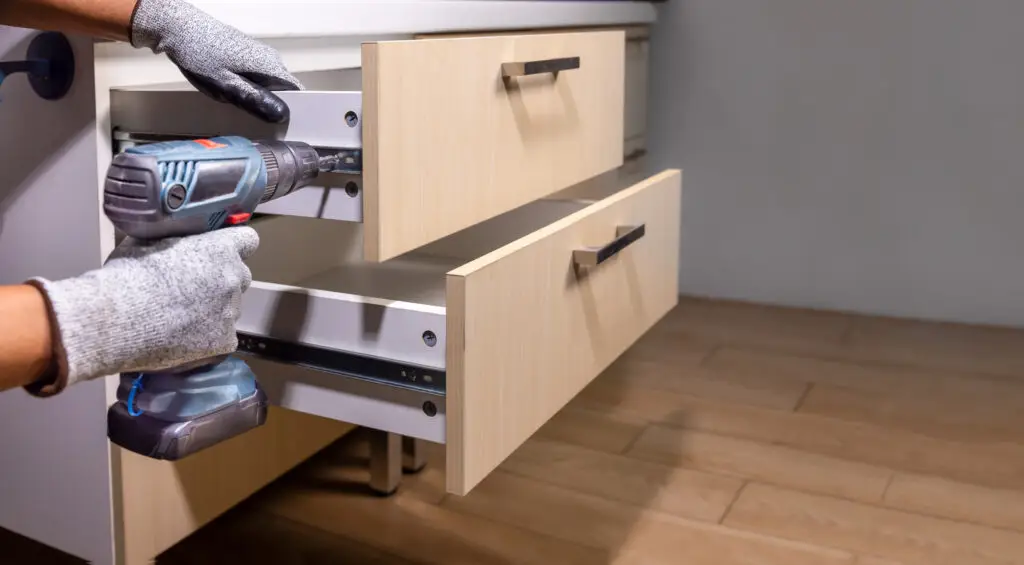
A Look at Emerging Hardware Technologies for OEMs.
Where the next generation of slides, hinges & systems is headed – and how Comtrad helps you plug in.
If you build cabinets, furniture, closets or casework at scale, hardware technology is changing under your feet.
Soft-close and full-extension used to be “nice upgrades.” Now they’re baseline expectations. At the same time, you’re being asked for:
Smarter, more integrated hardware
Cleaner, handle-less looks
Quieter, more durable motion
More sustainable material choices
The good news: the furniture hardware ecosystem is evolving fast. The challenge: OEMs need to decide which innovations actually belong in their product roadmap – and which are just noise.
Here’s a look at the most important emerging hardware technologies for OEMs, backed by current data and trends, and how a partner like Comtrad / CGS can help you adopt them without blowing up cost or complexity.
Soft-close isn’t new, but it’s still one of the biggest growth engines in furniture hardware.
Recent global research on the furniture hardware market notes that soft-close hinges and damped slides are among the fastest-growing categories, driven by demand for quieter, premium-feeling furniture. One analysis estimates soft-close hinge shipments exceeded 180 million units in 2024, with ~12% year-on-year growth.
For OEMs, the new wave of motion tech looks like this:
Advanced damping & multi-cushion close
Soft-close is moving beyond a single hydraulic damper:
Multi-stage damping to handle both light and heavy loads smoothly
Tuned “pull-in” forces so drawers don’t feel too stiff or too loose
Better performance across a wider temperature and humidity range
How CGS fits: Comtrad’s CGS3 and CGS Platinum full-extension cushion-close ball-bearing slides use multi-cushion closing technology and hydraulic cylinders, and are tested to KCMA, BIFMA and WCI performance standards, backed by a limited lifetime warranty.
That gives you “next-gen” soft-close behavior without having to engineer damping curves from scratch.
Push-to-open & handle-less systems
Handle-less kitchens and “invisible” millwork are driven by:
Minimalist aesthetics
Integrated and panel-ready appliances
Accessibility and touch-activated convenience
For hardware, that means:
Push-to-open slides (with or without soft-close)
Touch-latch mechanisms for doors
Reliable opening even on heavy, wide fronts
Comtrad/CGS angle: CGS undermount and ball-bearing programs include push-to-open and combined push-open + cushion-close options, all within the same dimensional families you already design around.
That makes it straightforward to offer a “handle-less upgrade” tier without re-platforming your whole line.
2. Smart & Connected Hardware: From Gimmick to Specifiable Feature
Smart home adoption is pushing intelligence all the way into cabinets and furniture:
Articles on smart kitchen cabinets highlight touchless doors, integrated lighting, and sensor-based access as growing trends in modern kitchens.
Wider smart-home coverage points to smart locks as one of the fastest-moving hardware categories, with new standards like Aliro and Matter improving interoperability and driving down costs.
For OEMs, you don’t have to turn every cabinet into a gadget—but a few clear directions are emerging:
Touchless or assisted-open doors in trash pull-outs, waste centers, and accessible kitchens
Integrated lighting tracks in drawers and closets triggered by door movement
Mechatronic locks for lockers, medicine cabinets, and office storage, controllable via phone or fob
The real opportunity is to design your casework and hardware platforms so these options can be layered in, instead of bolted on. That typically means:
Robust, full-extension slides that can handle extra weight and wiring
Consistent hinge families that leave space for sensors or cable routing
A hardware partner (like Comtrad) who can source specialized components around your CGS core rather than forcing you into an exotic, one-off system.
Finishes used to be mostly about color. Now they’re a technology decision.
PVD vs traditional electroplating
Multiple technical guides now note that traditional electroplating can suffer from chipping, flaking and tarnishing over time, especially once a clear coat breaks down.
By contrast, PVD (Physical Vapor Deposition):
Deposits a very hard, wear-resistant metallic layer in a vacuum
Offers superior scratch and corrosion resistance
No longer a “lab process” – it’s been scaled to handle complex parts at commercially viable cost
That’s why PVD finishes are showing up aggressively in door and cabinet hardware, especially for:
Matte black and “lifetime” brass finishes
Higher-end bath and kitchen environments
Zinc-Nickel & high-performance plating
Engineers have increasingly turned to zinc-nickel alloys as a more durable alternative to standard zinc plating:
Zn-Ni coatings can deliver 2–3× the corrosion resistance of plain zinc in salt-spray testing.
They also coat recessed and complex geometries more consistently, which matters for slides, hinges, and brackets.
For OEMs focused on laundry, bath, and high-humidity environments, these advances in finishes directly translate into:
Longer life before rust or pitting
Fewer warranty headaches
Better support for “lifetime hardware” brand claims
Where Comtrad fits: Comtrad’s CGS program already emphasizes heavy-gauge steel with robust zinc-based plating across its slide and hinge lines, tested to demanding cabinet and furniture standards.
As higher-end PVD and Zn-Ni solutions become mainstream, a sourcing partner with 40+ years of experience and a strong supplier network is exactly who you want navigating those options.
4. Space-Saving Mechanisms & Metal Drawer Systems
Space optimization is no longer just a “European kitchen” thing. A recent global furniture hardware outlook notes that storage accessories and lift-up solutions are growing at more than 28%, as consumers demand more functional, space-efficient designs.
For OEMs, that translates into:
Lift-up and stay-lift systems for upper cabinets and overhead storage
Metal drawer systems (single- and double-wall) for clean side profiles and easy internal organization
Heavy-duty slides for pantry pull-outs, utility drawers, and workplace storage
Comtrad’s catalog reflects this shift, with:
Ball-bearing slides in 100–500 lb load ranges for heavy-duty applications
Dedicated categories for metal drawer systems and stay-lift systems, all tied back into the CGS ecosystem and tested to KCMA/BIFMA/WCI where appropriate.
The emerging tech isn’t just new mechanisms – it’s coherent systems that let you deliver:
Thinner drawer sides with the same internal capacity
Taller sides for higher storage without racks tipping
Smoother, safer motion on heavy loads
5. Sustainability & Circular Design: Hardware as a Long-Life Component
Sustainability is no longer just about the wood. Trade groups like NKBA and design publications are explicitly calling out recycled metals and eco-friendly finishes in cabinetry and hardware as part of a “necessary evolution” in home design.
Key trends you should have on your radar:
Recycled and low-impact metals in knobs, pulls, and structural hardware
Finishes with lower environmental impact and longer service life (less frequent replacement)
Hardware designed for repair and reuse, supporting circular design principles
From a sustainability perspective, the most powerful thing hardware can do is last:
Fewer failures → fewer replacements → less material, shipping, and landfill
Consistent platforms like CGS slides and hinges make it easier to repair and retrofit existing installations instead of tearing out whole cabinets
Comtrad’s CGS line is explicitly positioned as long-service-life hardware, independently tested to KCMA, BIFMA, and Woodwork Institute standards and backed by a lifetime warranty and quality guarantee.
If you’re building sustainability messaging into your products, that kind of third-party-tested, long-life hardware is a critical foundation.
6. Modular & Quick-Install Thinking
Across hardware categories (not just furniture), there’s a clear shift toward modular, easily replaceable components:
In tech, companies like Dell are embracing modular ports and easily swapped parts to support circular design and reduce waste.
The same logic is creeping into cabinet and furniture hardware:
Standardized slide footprints and drilling patterns across multiple performance tiers
Clip-on hinges with robust adjustment but simple replacement
Rear-mounting brackets and quick-fit systems to cut install time and make future service simpler
CGS already embodies a lot of this thinking:
Common dimensional families and certifications across multiple slide series
Hinge lines built around consistent cup and plate geometry, with variants for self-close, soft-close, and different overlays
For OEMs, that modularity translates into:
Faster assembly and installation
Easier field service
The ability to “drop in” higher-performance hardware without re-engineering every time
What OEMs Should Do Next
If you’re planning your next 3–5 years of hardware strategy, here’s a practical way to use these emerging technologies:
Define your core platforms
Pick 1–2 CGS undermount slide families and 1–2 ball-bearing families that cover most of your use cases (with cushion-close, push-open, and heavy-duty options as needed).
Standardize on a CGS hinge family with soft-close and self-close variants for different product tiers.
Layer in emerging features where they matter
Use push-to-open and handle-less options in premium and design-forward lines.
Introduce lift-ups and metal drawer systems in storage-heavy SKUs.
Upgrade materials and finishes in high-stress environments
Select higher-performance finishes (PVD, Zn-Ni) or robust plated systems for laundry, bath, and coastal projects.
Align with sustainability expectations
Highlight that your hardware is independently tested for long life and backed by strong warranties, reducing replacements and waste.
Where possible, specify suppliers (like Comtrad) who are actively working with recycled and lower-impact materials and finishes.
Work with a hardware-focused supply specialist
Instead of chasing each emerging technology on your own, use a partner like Comtrad—with its CGS line, long sourcing history, and North American inventory—to bring these innovations into your product line without sacrificing cost control or supply reliability.
Emerging hardware tech doesn’t have to be overwhelming.
If you treat CGS slides, hinges, and systems as your stable backbone, you can selectively plug in smart features, advanced finishes, and sustainability upgrades where they’ll actually move the needle—for your customers and your margins.